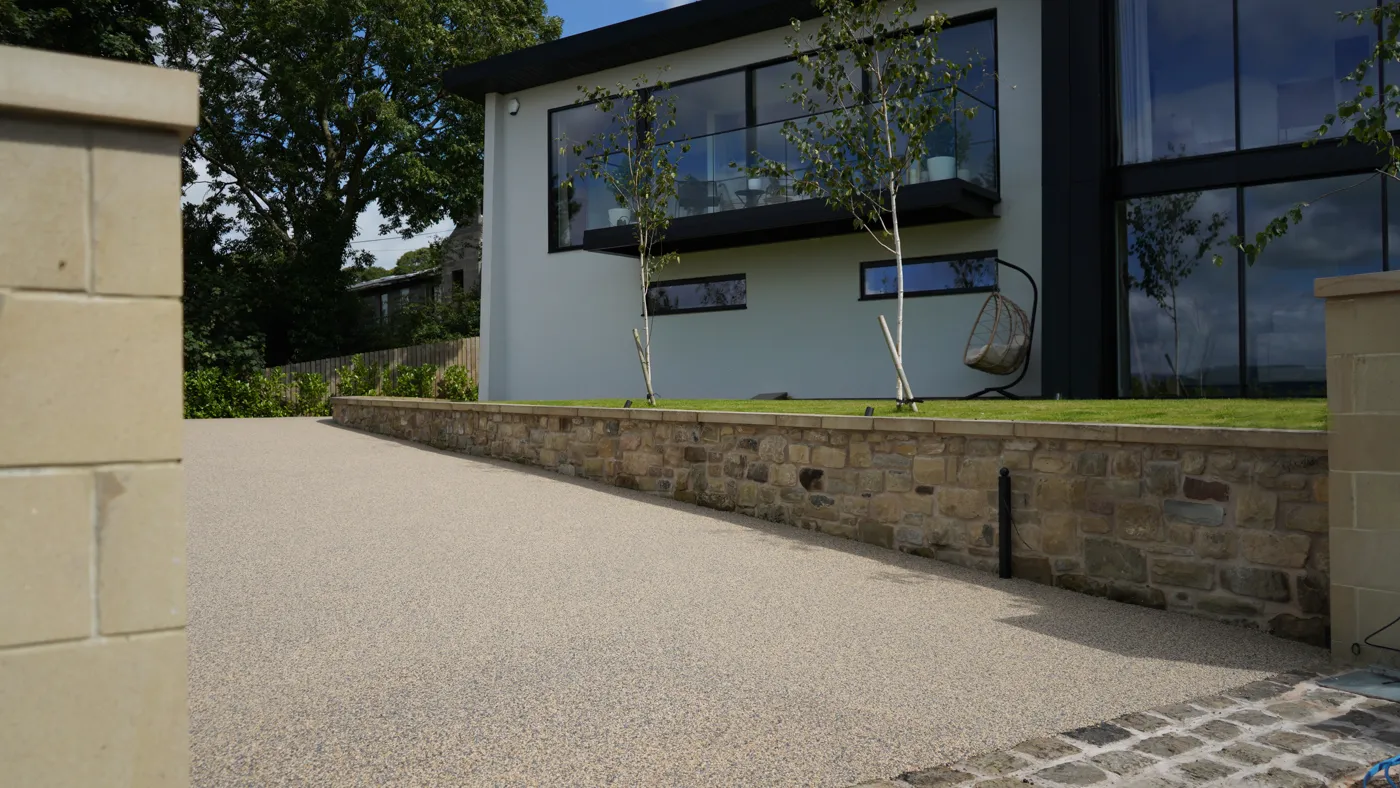
If your driveway is cracked, faded or just tired-looking, you might assume it all needs ripping up and starting again. But in many cases, we can overlay resin bound directly onto your existing surface — saving time, mess and significant cost.
Here’s how we assess whether an overlay will work for you.
When an Overlay Works
Resin bound can be applied over an existing surface when:
- The base is structurally sound — no major settling, heaving or subsidence
- The surface is stable — concrete that isn’t crumbling, tarmac that isn’t breaking up
- Drainage is adequate — the existing falls (slopes) direct water away from the property
- Levels allow it — adding 18–25mm of resin on top mustn’t raise the surface above your DPC (damp proof course) or garage threshold
When these conditions are met, an overlay is an excellent option. It avoids excavation, reduces waste, and can typically be completed in a single day.
Surfaces You Can Overlay
Tarmac / Asphalt
Tarmac is one of the best bases for resin bound overlay. It’s already black, stable and relatively smooth. The resin bonds to it well, and the result is a dramatic visual transformation. If the tarmac has minor surface cracking but no structural failures, an overlay is usually suitable.
Concrete
Concrete works well too, provided it’s not severely cracked or spalling (flaking on the surface). Hairline cracks are normally fine — we can seal them before applying the resin layer. If large sections of concrete have broken away or settled at different levels, that indicates a base problem that overlay alone won’t fix.
Block Paving
This is trickier. Block paving moves over time — individual blocks shift, creating an uneven surface. In some cases, we can stabilise the blocks and overlay, but more often we recommend removing the blocks and using the existing sub-base (which is often in good condition) for a new resin installation.
When an Overlay Won’t Work
We’ll always be honest if your driveway isn’t suitable for overlay:
- Structural cracks — cracks wider than 5mm, or evidence of ground movement, mean the base has failed. Overlaying would simply crack again.
- Significant settling — if parts of the driveway have sunk, that indicates sub-base failure. This needs proper groundwork to fix.
- Poor drainage — if water currently pools on the surface and the falls can’t be corrected within the overlay thickness, you need a regrading.
- Unstable surface — loose gravel, crumbling concrete or deteriorated tarmac that comes away in chunks won’t provide a reliable bond for the resin.
In these situations, we recommend a full driveway resurfacing with new groundwork. It costs more but gives you a guaranteed result that’ll last 25 years.
How We Assess Your Driveway
During your free survey, we check:
- Surface condition — cracking, spalling, loose areas
- Structural integrity — we walk the entire surface checking for soft spots and movement
- Levels and falls — ensuring water will drain correctly with the added resin layer
- DPC clearance — the finished surface must sit at least 150mm below your damp proof course
- Edge conditions — the perimeter needs solid edging to contain the resin
We photograph everything and give you an honest assessment. If an overlay will work, we’ll quote for it. If it won’t, we’ll explain why and quote for the proper solution instead.
Cost Savings
An overlay avoids:
- Excavation labour and machinery
- Skip hire and waste disposal
- New sub-base materials
- Reinstatement of edges and levels
This typically makes an overlay 30–50% cheaper than a full replacement, while delivering the same beautiful resin bound finish on top.
The Bottom Line
Don’t assume your old driveway needs ripping out. A significant proportion of the driveways we install across Cheshire and North Wales are overlays onto existing tarmac or concrete. The finish is identical to a full installation — the only difference is less disruption and lower cost.
Curious whether your driveway is suitable? Book a free survey and we’ll tell you straight.